

Part of the series: 2026 Policy Updates
- Bali PT PMA Restrictions 2026: What Changed for Foreign Investors
- PT PMA Compliance 2026: What Existing Bali-Based KBLI Holders Need to Know and Do Before 18 June
- PT PMA Establishment 2026: Pre-Formation Framework for Bali-Based Enterprises
- Bali Property in 2026: Perda No. 4 of 2026, the Nominee Prohibition, and the Compliant Investment Structure
Bali Policy Update 2026 | Article 1 of 4
Published 27 May 2026. Last updated 08 October 2026. Law stated as at 08 October 2026. By Tracy Wilkinson.
Article 2 in this series addresses the compliance obligations of existing PT PMA holders in Bali directly. Article 3 covers new PT PMA formation under current conditions. Article 4 addresses property and land exposure under Perda No. 4 of 2026. This article sets out the regulatory landscape that sits behind all three.
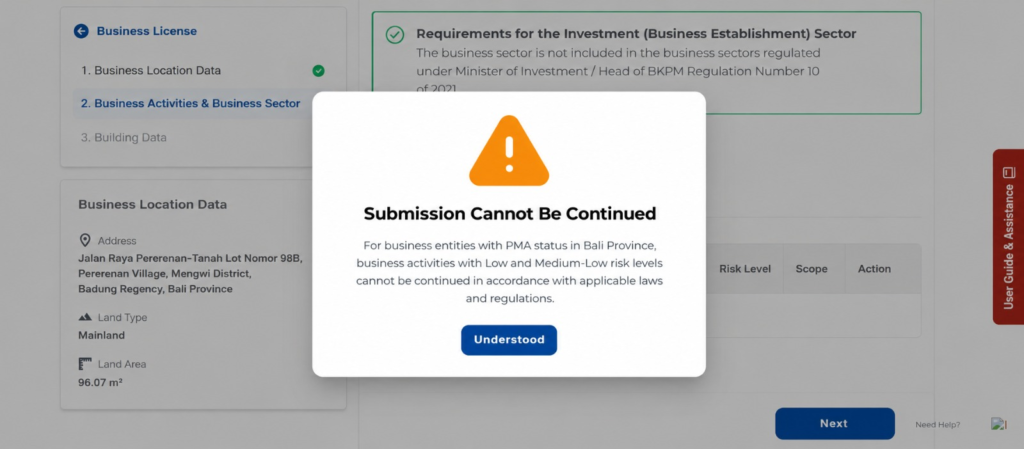
The Bali PT PMA restrictions took effect in the third week of May 2026, when the Online Single Submission (OSS) system began refusing new applications from foreign-owned companies (Penanaman Modal Asing, or PT PMA) in Bali for business activities classed as low risk or medium-low risk. The Bali Provincial Government confirmed the closure on 22 July 2026 and named 18 business classifications (Klasifikasi Baku Lapangan Usaha Indonesia, or KBLI) as closed. Licences issued before the closure remain valid. The KBLI 2025 classification has replaced KBLI 2020 in OSS since mid-June 2026, and most existing codes converted automatically.
In brief
- OSS refuses a new PT PMA application in Bali for any KBLI classed as low risk or medium-low risk. TraceWorthy has confirmed this position across OSS applications for several clients.
- The province’s published list names 18 KBLI, including other management consultancy (70209), real estate (68111), and car and motorbike rental (77100 and 77311).
- A PT PMA licensed before the closure keeps its licence. Exposure arises when the company lodges an amendment, a new project or a new KBLI in OSS.
- OSS accepts a virtual office as a PT PMA’s registered address. A project address must still satisfy the zoning and building requirements for the activity.
- Under KBLI 2025, a code that only changed its number converted automatically. A company whose old code split into several new codes selects the code that matches its actual activity.
- Bali Regional Regulation No. 4 of 2026 prohibits nominee land arrangements and reaches the intermediaries who arrange them.

What has Bali restricted for new PT PMAs?
The Bali PT PMA restrictions began as a provincial request. On 10 December 2025, the Governor of Bali wrote to the Minister of Investment and Downstream Industry / Head of BKPM asking for the closure of KBLI 70209 (other management consultancy activities) in Bali. The letter stated that PT PMA registered under that code used the Business Identification Number (Nomor Induk Berusaha, or NIB) as a means of residence for foreign nationals, with no productive activity and only a virtual office lease. A second letter, ref. B.27.000/642/PM/DPMPTSP and dated 28 January 2026, asked the Ministry to close OSS access for new PT PMA in low and medium-low risk activities, according to published reports of that letter.
OSS began refusing these applications in the third week of May 2026. On 22 July 2026, Governor Wayan Koster announced the closure with the approval of the Minister.
Government Regulation No. 28 of 2025 on the Implementation of Risk-Based Business Licensing provides the wider framework. On 14 July 2026, the head of the Bali Investment and One-Stop Integrated Services Agency (DPMPTSP) explained that every application is now verified by the regional government, and that an NIB can be revoked where it conflicts with spatial planning or other requirements.
TraceWorthy performs OSS applications for PT PMA clients in Bali, and those applications show how the block operates in practice. OSS refuses every low and medium-low risk KBLI for a PT PMA domiciled in Bali or adding a project address in Bali. Moving the registered address outside Bali does not reopen access for a project located in Bali.
Why has the Bali Provincial Government restricted PT PMA activities?
The province has given two reasons for the restriction. The first reason is the use of PT PMA licensing as a route to residence, which the Governor’s letter of 10 December 2025 described for KBLI 70209. The letter also recorded breaches of the IDR 10 billion minimum investment value and set out the following effects of the practice:
- loss of regional revenue from taxes and levies;
- growth in the foreign population without spatial planning;
- weak environmental supervision;
- low absorption of local labour and an unhealthy investment climate.
The second reason is the protection of micro, small and medium enterprises and cooperatives. The province’s announcement of 22 July 2026 stated that low and medium-low risk activities require only an NIB, and that this route had allowed foreign capital into sectors where local businesses operate.
To understand why these interventions arrived when they did, the scale of PT PMA activity in Bali over the preceding four years provides necessary context. According to provincial data cited by multiple sources, Bali accounted for nearly 40% of all PT PMA registrations issued nationally between 2021 and 2025. During that period, in excess of 19,000 foreign-owned companies registered in excess of 55,000 projects in the province, the majority operating in low-risk sectors requiring only a Business Identification Number (Nomor Induk Berusaha, or NIB) to commence activities. Realised foreign direct investment in Bali grew from approximately IDR 4.22 trillion in 2020 to IDR 24.21 trillion in 2024. By the close of 2025, Bali’s PMA realisations stood at IDR 25.60 trillion, equivalent to approximately 2.84% of Indonesia’s total national FDI realisation for the year.
These figures confirm genuine foreign investor activity in Bali. They also confirm the scale of the pattern that provincial authorities identified as requiring intervention. Bali represents approximately 1.57% of Indonesia’s total population, receives 44% of Indonesia’s international tourist arrivals, and generated 40% of its PT PMA registrations over a four-year period.
Population share
1.57%
of Indonesia
Share of national FDI
2.84%
2025 realisation
Share of PT PMA registrations
~40%
2021–2025 nationally
Share of international arrivals
44%
6.94 million in 2025
(2021–2025)
arrivals (2025)
Sources: BPS; BKPM; DPMPTSP Bali; provincial data cited by multiple sources (2025–2026). PT PMA registration share from provincial data. FDI share calculated from DPMPTSP and BKPM reported figures.
That concentration, combined with sustained enforcement findings of substance-free registrations and residency-motivated structuring, is the foundation on which the regulatory response has been built.
National enforcement preceded the provincial request. In November 2024, BKPM revoked the NIBs of 267 PT PMA in Bali that had not met the IDR 10 billion minimum investment value. In January and February 2025, the Directorate General of Immigration led two phases of a joint enforcement operation, Operation Wira Waspada, with the police, the prosecution service and BKPM. The first phase found 74 of the 267 companies still acting as sponsors for 126 foreign nationals. Across both phases, the operation identified 520 foreign nationals linked to problematic or fictitious companies, and 63 had been deported and banned from re-entry by 21 February 2025.
The provincial restriction applies at the licensing stage the same test that these enforcement actions applied after licences were issued. A PT PMA must carry on the business its KBLI describes and realise the investment it has committed.
Which KBLI codes are affected?
The province named 18 KBLI when it announced the closure. The codes below are reproduced as the province published them.
| KBLI | Activity |
| 14120 | Tailoring and made-to-order clothing |
| 47249 | Retail sale of other food |
| 47511 | Retail sale of textiles |
| 47711 | Retail sale of clothing |
| 47991 | Mobile retail sale of agricultural food products |
| 55110 | Star hotels with a building area under 6,000 m² |
| 55120 | Budget (melati) hotels with a building area under 6,000 m² |
| 55900 | Other accommodation |
| 56303 | Drinking establishments and cafés |
| 56305 | Traditional medicine shops |
| 68111 | Real estate, owned or leased |
| 70204 | Industrial management consultancy activities |
| 70209 | Other management consultancy activities |
| 77100 | Rental of cars, buses, trucks and similar vehicles |
| 77311 | Motorbike rental without an option to purchase |
| 93111 | Stadium facilities |
| 93116 | Fitness centres |
| 93191 | Organisation of sports activities |
Several of these numbers come from KBLI 2020. Under KBLI 2025, 55110 divides by star rating into 55101 (five-star) to 55105 (one-star), and non-star hotels fall under 55106. A company should check the converted code that OSS displays for its own activity.
The list of 18 is narrower than the PT PMA restrictions in Bali as OSS applies them. On 14 July 2026, the head of DPMPTSP Bali referred to 64 closed KBLI, 52 low risk and 12 medium-low risk, and said that further closures had been proposed, including modern retail chains. OSS applies the block by risk level. The deciding question for any code is therefore the risk level that OSS displays for the company’s scale of business.
KBLI 79121 (travel agency activities) shows how the risk test works. The Governor’s January letter named 79121, and the code does not appear in the July list of 18. OSS classes KBLI 79121 as medium-high risk for both a medium business and a large business, which places 79121 outside the block. TraceWorthy’s client applications confirm that a Bali PT PMA can still register KBLI 79121.

Villa activities fall under a separate national rule. KBLI 55203 (villa activities, formerly 55193 under KBLI 2020) is reserved for cooperatives and micro, small and medium enterprises under Presidential Regulation No. 10 of 2021 on the Investment Business Sector, as amended by Presidential Regulation No. 49 of 2021. KBLI 55203 is therefore not available to a PT PMA anywhere in Indonesia, independent of the Bali closure.
Do the Bali PT PMA restrictions affect an existing licence?
A PT PMA licensed before the closure keeps its NIB and its licences. The province has stated that a company with an existing licence in a closed code continues to file the Investment Activity Report (Laporan Kegiatan Penanaman Modal, or LKPM) until the code is deactivated or removed from OSS. Our guide to PT PMA compliance for existing Bali licence holders sets out the reporting cycle in full.
Exposure arises at the points where a company interacts with OSS. The following actions can bring an existing PT PMA into contact with the block:
- adding a new KBLI or a new project location in Bali;
- amending the company’s data or business activities in OSS;
- amending the articles of association in a way that changes the business activities;
- applying for a further licence or certificate under a closed code.
Projects created before the closure are retained in OSS. TraceWorthy therefore reviews any proposed corporate change before an amendment is lodged, and does not lodge an amendment that touches an existing project record.
DPMPTSP Bali also performs field inspections of PT PMA, and these inspections are taking place in practice. On 2 October 2026 the agency reported that only five PT PMA had motorbike rental licences, against an estimated 400 to 500 operators. The same report described single addresses registered to 22 or more NIBs. Inspections compare a company’s actual activity and realised investment with its registered KBLI.
Planning an amendment, a new project or a new KBLI for a PT PMA in Bali? Message the TraceWorthy team on WhatsApp or book a consultation before anything is lodged in OSS.
Can a PT PMA still use a virtual office in Bali?
A PT PMA has two addresses in OSS, and OSS tests each one differently. The registered address is the company’s domicile in its articles of association. The project address is the location where the business activity takes place.
OSS accepts a virtual office as a PT PMA’s registered address in Bali. TraceWorthy’s applications for clients confirm this position on virtual office use by a PT PMA. Some published reports since May 2026 describe a ban on virtual offices for PT PMA in Bali. The Governor’s letter of 10 December 2025 carries a subject line on virtual office use, and its operative request is the closure of KBLI 70209. The letter does not ask OSS to reject a virtual office as a registered address.
A virtual office can fail as a project address. The project location must meet the basic requirements of risk-based licensing under Government Regulation No. 28 of 2025. TraceWorthy reviews each of the following separately for every project address:
- spatial use conformity (Kesesuaian Kegiatan Pemanfaatan Ruang, or KKPR) for the zone in which the address sits;
- building approval (Persetujuan Bangunan Gedung, or PBG) for the building’s function;
- the certificate of building function (Sertifikat Laik Fungsi, or SLF);
- the company’s right to use the premises, through a lease or other title.
These zoning and building requirements may prevent a virtual office being used as the project address for an activity that needs physical premises, such as accommodation, retail or vehicle rental.
What does Perda No. 4 of 2026 mean for nominee land arrangements?
Bali Regional Regulation No. 4 of 2026 on the Control of Productive Land Conversion and the Prohibition of Nominee Land Ownership Transfers was signed by the Governor on 24 February 2026. The regulation addresses the conversion of productive agricultural land and the transfer of land control to foreign nationals through nominee arrangements.
Nominee arrangements are illegal under Indonesian law. Article 26(2) of Law No. 5 of 1960 on Basic Agrarian Principles renders void any transfer that places freehold title (Hak Milik) under the control of a foreign national. Perda No. 4 of 2026 adds provincial enforcement. Article 1(11) defines a nominee arrangement as an agreement or arrangement that appoints a person to own or manage land rights in the name of a foreign national who is the beneficial owner. Article 14 prohibits any person from acting as an intermediary or facilitator, or providing the means, that causes a foreign national to control land ownership through a nominee arrangement. The explanatory notes define an intermediary as a person or institution that acts as the link in the transfer, and a facilitator as a person or party that helps, eases or supports it.
Article 20(1) applies administrative sanctions to any breach of Article 13(2), which prohibits the conversion of designated productive land, and of Article 14. Article 20(2) sets out the sanctions:
- written warnings;
- temporary suspension of activities and site closure;
- revocation or cancellation of permits;
- demolition of buildings and restoration of the land’s function;
- revocation of incentives;
- administrative fines.
Civil servants who breach Article 13(2) or Article 14 face the same administrative sanctions, applied through career measures under civil service rules (Article 20(3) and (4)). The regulation contains no criminal provisions of its own. Article 20(5) provides that criminal sanctions may be imposed in addition to the administrative sanctions, in accordance with the applicable laws and regulations, and names no specific offence or penalty. Any prosecution therefore relies on national legislation. The national laws listed as the regulation’s legal basis include Law No. 5 of 1960 on Basic Agrarian Principles and Law No. 41 of 2009 on the Protection of Sustainable Food Agricultural Land. The regulation took effect on its promulgation on 24 February 2026 (Article 26). Our analysis of Perda No. 4 of 2026 and Bali land covers land structures and due diligence in detail.
What happened at the 18 June KBLI 2025 migration deadline?
KBLI 2025 was established by BPS Regulation No. 7 of 2025, issued on 18 December 2025, and replaces KBLI 2020. A Joint Circular dated 25 March 2026 governs its use in risk-based licensing. The Joint Circular was issued by the Minister of Investment and Downstream Industry / Head of BKPM (No. 4.S of 2026), the Minister of Law (No. M.HH-1.HH.04.02 of 2026) and the Head of Statistics Indonesia (BPS) (No. 1 of 2026).
The 18 June 2026 date in the Joint Circular applied to the two ministries. Point 5(d)(4) required BKPM and the Ministry of Law to complete the KBLI 2025 adjustment of OSS and of the Ministry of Law’s legal entity system (AHU) by that date. OSS moved to KBLI 2025 in mid-June 2026.
For an existing company, the Joint Circular sets out four outcomes:
- licences issued before KBLI 2025 remain valid (Point 5(d)(1)), as BPS has confirmed;
- a code that changed only its number converts automatically in OSS and AHU, with no amendment to the deed (Point 5(d)(3));
- a change to the company’s purpose, objectives or scope of activities requires an amendment to the articles of association through AHU (Point 5(d)(2));
- where OSS cannot convert a code, OSS sends a notice, and licence issuance waits until the company corrects its data in AHU (Annex I).
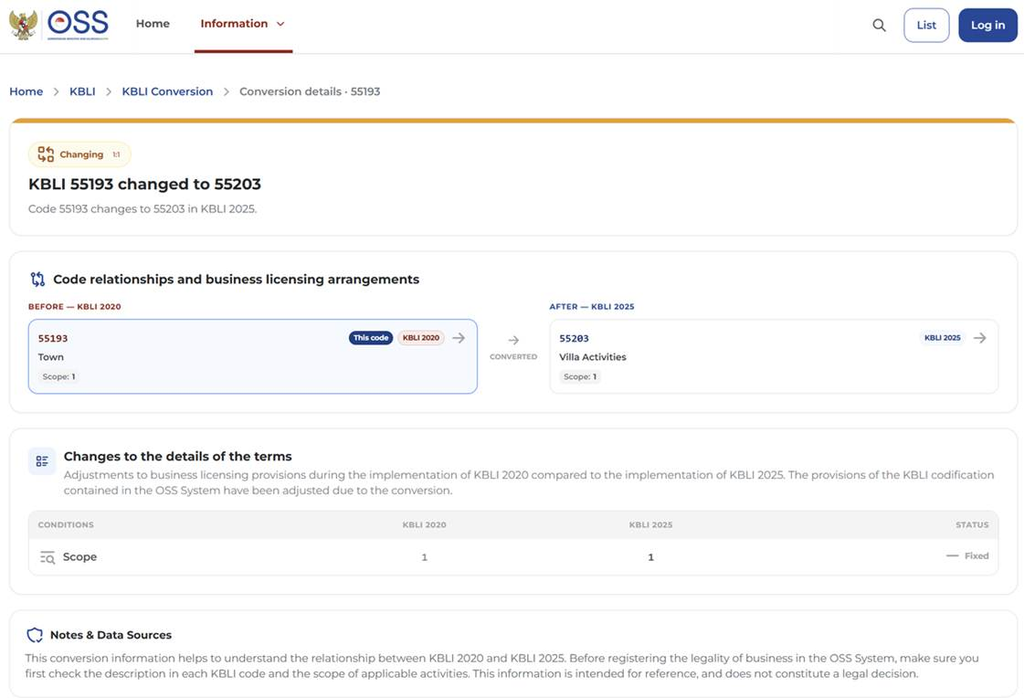
Split codes are decided case by case. Where one KBLI 2020 code divides into several KBLI 2025 codes, the company selects the code that matches its actual activity. A star hotel registered under 55110, for example, selects the KBLI 2025 code for its star rating. TraceWorthy maps each client’s new code from the client’s actual service model and records the risk level that OSS displays, with the date of the check, because the risk level decides whether the Bali block applies. Our guide to KBLI 2025 migration for PT PMA explains the conversion models in more depth.
What must travel agents and accommodation on booking platforms do?
A travel agency under KBLI 79121 needs a Standard Certificate. The code is unchanged in KBLI 2025. OSS shows a 14-day term in the tourism sector, and for a PT PMA the certificate is issued under the authority of the Minister of Investment and Downstream Industry / Head of BKPM. KBLI 79121 is classed as medium-high risk and sits outside the Bali block.
Villas and other alternative accommodation listed on online travel agents (OTAs) face a separate licensing deadline set by the Ministry of Tourism. The deadline moved from 31 March 2026 to 31 May 2026. On 26 May 2026 the Minister of Tourism announced that unlicensed accommodation would be removed from OTA platforms from 1 August 2026. The Ministry identified approximately 1,600 unlicensed accommodation businesses on OTAs before that date. No official count of listings removed after 1 August 2026 has been published.
The Ministry’s arrangements with nine OTAs, including Airbnb, Booking.com, Agoda and Traveloka, require the following:
- OTAs stop marketing unlicensed accommodation;
- OTAs obtain an NIB and KBLI from every new merchant before onboarding;
- OTAs notify merchants without licences that their listings will be removed;
- once the planned verification system launches in June 2027, OTAs list only accommodation with a valid NIB and KBLI.
An accommodation business owned through a PT PMA must also check its KBLI against the Bali block, because hotels under 6,000 m² and other accommodation appear in the province’s list of 18.
Understanding Your Position in the Current Landscape
The Bali PMA regulations 2026 environment involves five distinct regulatory developments, each with its own timeline, operative mechanism, and category of affected entity. The chart earlier in this article illustrates the scale of the provincial policy concern that underlies all of them.
Existing PT PMA holders in Bali should understand that their existing NIB remains valid and their licence is not subject to cancellation. The risk arises at OSS interaction points, not at continued operation. The first question to resolve before initiating any OSS filing is whether your registered KBLI code carries a low-risk or medium-low risk classification under the OSS risk-based approach. Article 2 sets out the specific compliance steps and action sequence in full.
Prospective investors and those with Bali land interests will find the corresponding frameworks in Articles 3 and 4 respectively. Given the pace at which the policy environment is developing, a current legal position assessment before committing to any corporate or land transaction in Bali is the single most effective risk management step available.
TraceWorthy performs KBLI mapping, OSS applications and corporate amendments for PT PMA in Bali, and checks each proposed change against the Bali PT PMA restrictions before anything is lodged. Message the TraceWorthy team on WhatsApp or book a consultation to review your company’s position. Our services page sets out the full scope of support.
Frequently Asked Questions
Licences issued before the closure remain valid, and the province has announced no retrospective cancellation. Exposure arises when the company lodges an amendment, a new project or a new KBLI in OSS. DPMPTSP inspections also compare the company’s actual activity with its registered KBLI.
Under the Bali PT PMA restrictions, OSS refuses every KBLI classed as low risk or medium-low risk for a PT PMA with a Bali registered address or a Bali project address. The province published a list of 18 codes on 22 July 2026. For any code outside that list, the risk level displayed in OSS decides the position.
OSS accepts a virtual office as a PT PMA’s registered address. A project address must meet the zoning, building approval and building function requirements for the activity. Those requirements may prevent a virtual office being used as the project address for an activity that needs physical premises.
A PT PMA does not need IDR 10 billion in paid-up capital. Regulation of the Minister of Investment and Downstream Industry / Head of BKPM No. 5 of 2025 sets the minimum paid-up capital at IDR 2.5 billion (Article 26). IDR 10 billion is the minimum investment value per KBLI per project location, excluding land and buildings (Article 25). Our guide to paid-up capital for a PT PMA works through the calculation.
The block applies to a project address in Bali as well as to a registered address in Bali. Moving the registered address to Jakarta or another province does not reopen access for a low or medium-low risk activity located in Bali.
Most codes changed only their number and converted automatically in OSS. Where an old code split into several new codes, the company selects the code that matches its actual activity. A change of scope requires an amendment to the articles of association. Compare the code OSS now displays with the activity the company performs. Our overview of KBLI restrictions for foreign investors covers the national rules that apply alongside the Bali block.
This article provides general information only. It does not constitute legal advice and does not address any specific company’s circumstances. The regulatory environment described is active and evolving; the information reflects sources available at the time of publication and will be updated as the policy position develops. Readers should obtain specific advice from a qualified legal adviser before taking any action in relation to their PT PMA or business interests in Bali. TraceWorthy provides advisory and legal drafting services for PT PMAs, foreign investors, and expatriates operating in Bali and across Indonesia.